
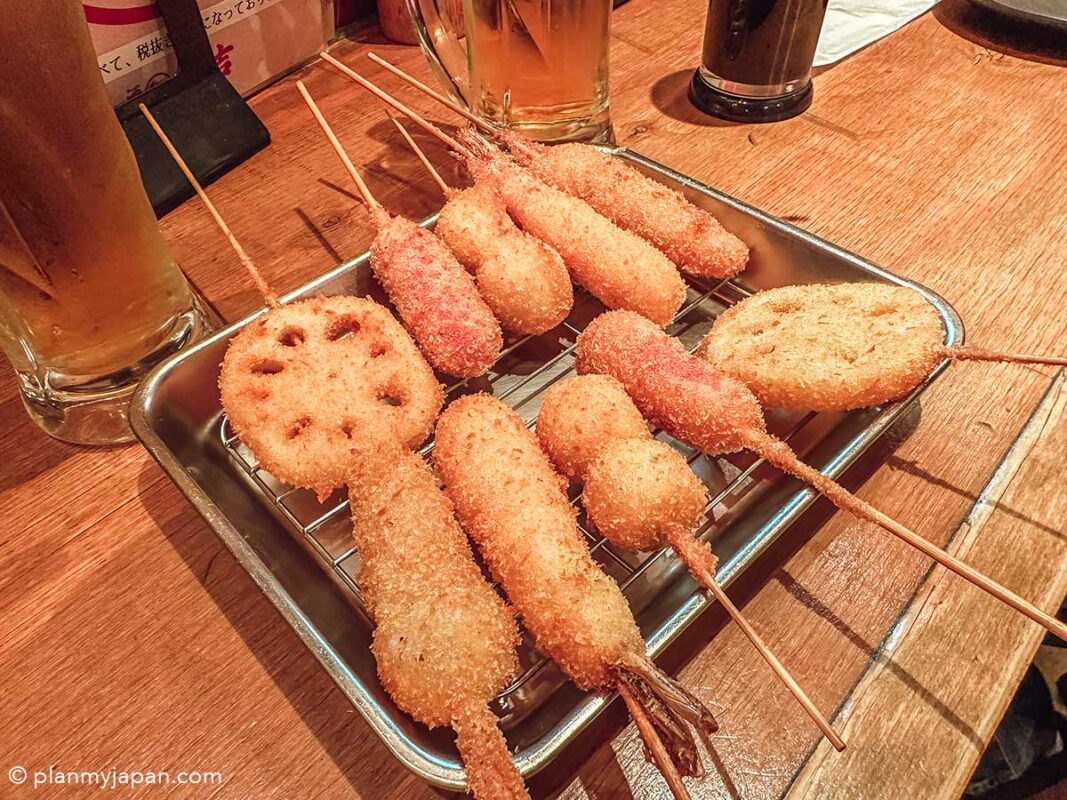
Kushikatsu skewers of meat and veg are one of Japan’s most popular dishes, originating from Osaka and enjoyed all over the country.
This post may contain affiliate links to tours and hotels. These help us earn a small commission at no additional charge to you.

With dozens of Japanese chain restaurants and independent izakayas (bars) dedicated to delivering the very best kushikatsu, this is fine fast-food, Japanese style – and very cheap too!
From eating etiquette (no double dipping!) to the streets of Shinsekai where the dish is revered, here is our guide to kushikatsu / kushiage in Japan with photos.
You might like – 35 tastiest Japanese foods to try (including kushikatsu) >
Japan checklist
We love using booking.com and agoda.com (use the Agoda code TAIWANDERERS for a discount) for researching and booking all our hotels. You can also purchase eSIMs from Airalo.
For booking tours, transfers and SIM cards we recommend Get Your Guide, Viator or Klook.
For booking rental cars visit Discover Cars.
Check out our Japan travel resources page >
What Is kushikatsu?
Kushikatsu (串カツ in Japanese) is also known as kushiage (串揚げ)
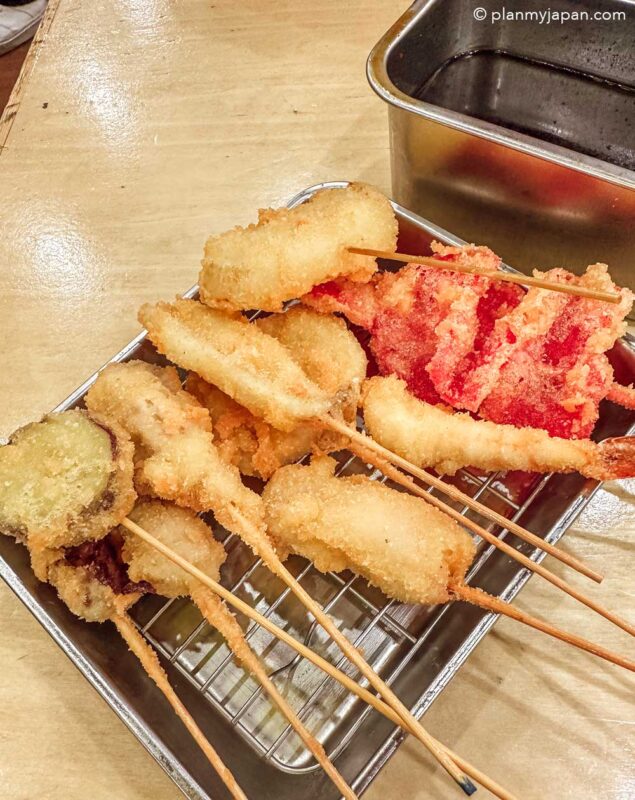
Kushikatsu is deep-fried breadcrumbed (panko) meat, fish and vegetables that are served on skewers (and best accompanied with a cold beer, in our humble opinion!).
‘Kushi’ refers to the bamboo stick or wooden skewer the food is placed on, whilst ‘katsu’ means ‘cutlet’, and is an abridged version of the fuller term ‘katsuretsu’.
Join our Facebook Japan Travel Tips Group!
Need help with your Japan itinerary or have any questions?
Head on over to our friendly Facebook group with 130,000+ members and ask the experts!
Click here to join our group >
We also run a brand new Japan Hauls, Souvenirs and Shopping Tips group >
Or if you just want to see more of our Japan photos and videos, follow our Plan My Japan Facebook page >
You might like – 20+ best (and cheap!) chain restaurants in Japan >
History of kushikatsu / where is kushikatsu from?
Kushikatsu is said to have originated in Osaka’s Shinsekai ‘New World District’ district in the late 1920s.

Izakayas (Japanese pubs) started serving kushikatsu skewers as a cheap snack to encourage workers to come in after work. They’d grab several deep-fried skewers and then go on to stay all night buying beer and sake. Simple but clever!
Because the ingredients were inexpensive for the izakaya owners (small cuts of meat, fish and vegetables), it created good profits and kushikatsu is now as popular as ever!
You might like – Plan My Japan’s Shinsekai neighborhood guide >
What is the difference between kushikatsu and kushiage?
Both terms ‘kushikatsu’ and ‘kushiage’ are interchangeable and either can be used in a Japanese restaurant and the owners will know what you mean.
The only variation is that originally, kushikatsu relates to the original Osaka dish, whilst kushiage relates to skewers from any other part of Japan.
“Age” in Japanese also means to fry so Kushiage means ‘skewer fry’ whilst kushikatsu means ‘skewer cutlet’.
Either way, both taste delicious so make sure you have some next time you are in Japan.
You might like these Japan chain restaurants guides
A Happy Pancake >
CoCo Ichibanya >
Denny’s >
Kura Sushi >
Matsunoya Tonkatsu >
Mister Donut >
Saizeriya >
Kushikatsu eating etiquette / the kushikatsu experience
If you go to Japan, you absolutely must try kushikatsu – it is a cheap dish, and so delicious with lots of different skewers you can choose from.
If you are vegetarian, kushikatsu is a good option too as there are many skewered vegetable choices. We particularly liked the lotus root kushikatsu as it has some nice texture and lots of flavor.
The other great thing is that the reason it was created back in the 1920s is still true today – to cater for workers in search of a cheap bite to eat after work.
Most kushikatsu restaurants or izakayas serving kushiage are full of office workers chewing on skewers and chugging on cold beers or sake – kanpai (cheers)!

You might like – 20+ unusual, weird and wonderful things to do in Japan >
However, if you are going to try kushikatsu in Japan, there is one GOLDEN RULE you must obey – if you don’t do this, you’ll get sent home on the next flight back (only joking but you can see where we are going with this).
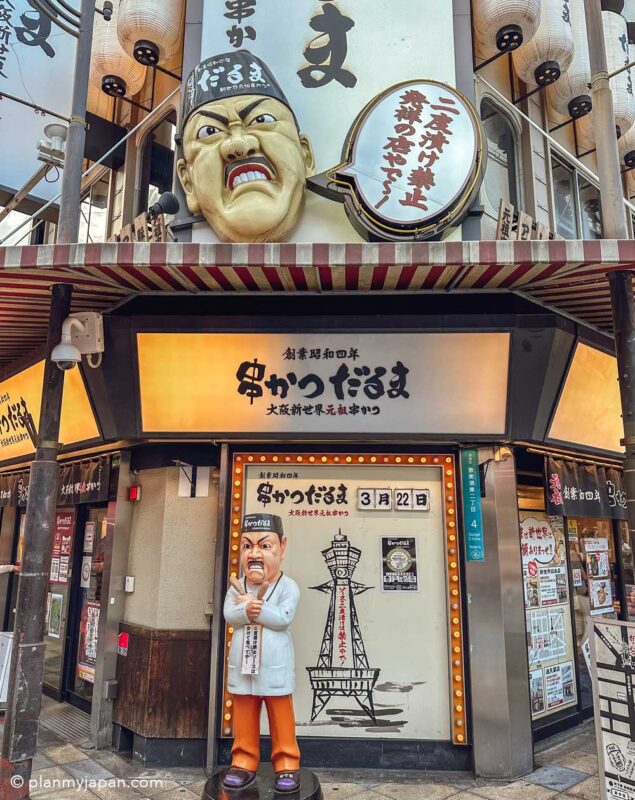
The first and only rule of kushikatsu – DO NOT DOUBLE DIP in the communal kushikatsu sauce!
Literally every kushikatsu joint has a huge pot of special sauce, usually a thick syrup sauce made from soy sauce or tonkatsu sauce mixed with Worcestershire sauce, spices plus other ‘secret ingredients’ – by secret, we mean each restaurant has their own take on kushikatsu sauce.
So whatever you do, pour your sauce onto the plate or use a spoon to ladle it on – just don’t double dip your actual skewers.
You might like these Tokyo neighbourhood guides:
Akihabara
Asakusa
Ginza
Harajuku
Ikebukuro
Nakano
Odaiba
Ryogoku
Shibuya
Shimokitazawa
Shinjuku
Also check out our
Where to stay in Tokyo guide
Why is there cabbage with Kushikatsu?
Most kushikatsu restaurants also serve up the skewers with a side of cabbage (certainly true of all the Osaka restaurants we went to) – but why is this?
Well, there are two main reasons – one, cabbage is said to help with digestion (it is a common side dish to nibble on in Japan), but secondly, it also helps you get around the double dipping problem. You can use the cut cabbage leaves as a kind of scoop which you then eat with the skewer.
One thing to mention – some kushikatsu restaurants (especially in tourist districts) are sometimes said to charge extra for the cabbage. It isn’t exactly a scam as such but some tourists feel short-changed when they see this added to the bill.
However, many places include it as part of the set menu. So if in doubt, ask the serving staff or check the menu small print.

Try this – Try kushikatsu on this Osaka food tour (13 delicious dishes at 5 local eateries) >
Kushikatsu prices in Japan
The prices vary across Japan, but kushikatsu is one of the cheapest foods to try in Japanese restaurants and bars. Prices for the basic skewers usually start from 100 Yen upwards.
As an example, the prices of the various skewers in Kushikatsu Daruma, the biggest kushikatsu chain are as follows:
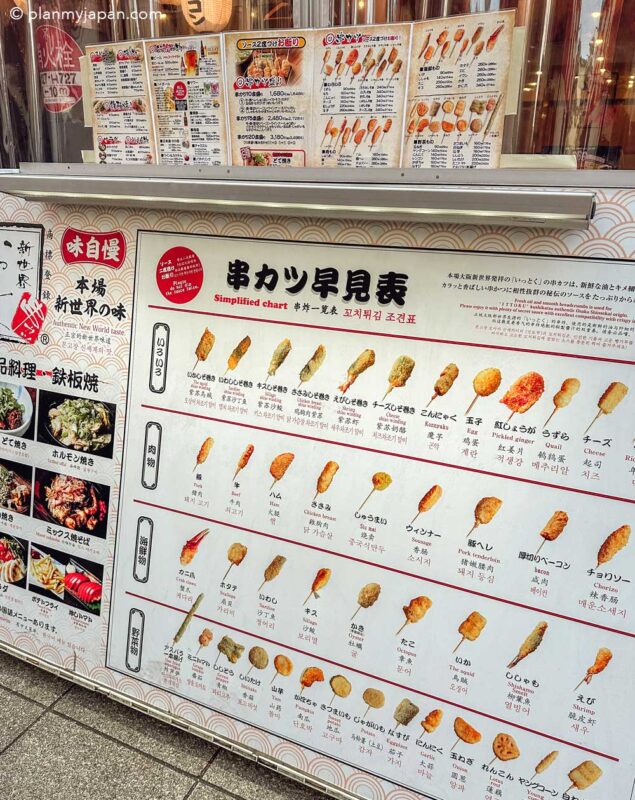
- Classic beef – 120 Yen (equivalent £0.60 or $0.80 USD a skewer)
- Quail egg, fish sausage or octopus skewers – 120 Yen
- Vegetarian skewers: Lotus root, asparagus, red ginger or sweet potato – 120 Yen
- Camembert cheese, spicy seasoned cod roe or oyster – 180 Yen
- Scallops, karaage, tongue or shrimp – 240 Yen
All Kushikatsu Daruma prices are correct as of summer 2024 and exclude tax.
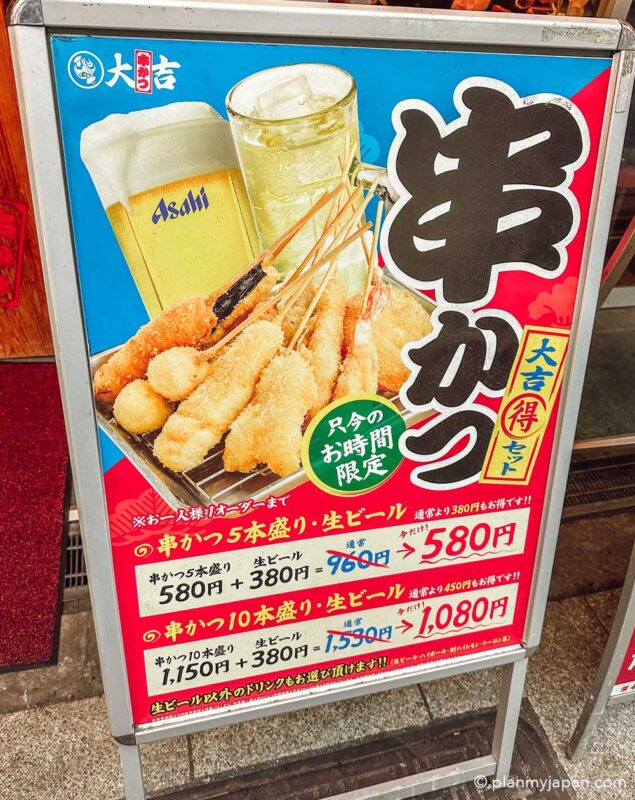
You’ll also find lots of specials in other restaurants, for instance, when we went to Kushikatsu Daikichi Shinsekai for the happy hour menu, we got 5 skewers each and a beer for 580 Yen per person (around $3.75 USD or £2.90).

Try this – Osaka local foodie walking tour in Dotonbori and Shinsekai >
Spotlight on Shinsekai, the spiritual home of the skewer
Shinsekai in Osaka is something else, a vintage Osaka neighborhood full of retro restaurants, bright neon lights and the famous Tsutenkaku Tower.

Known as Osaka’s ‘New World’ District, it is fine to visit any time of day but Shinsekai comes alive at night. As well as late night-shopping, street karting and retro arcades, it has numerous kushikatsu restaurants including some that are open 24 hours!

The most famous Osaka kushikatsu chain is Kushikatsu Daruma (the comic chef character holding skewers), with over 10 locations in Osaka alone.

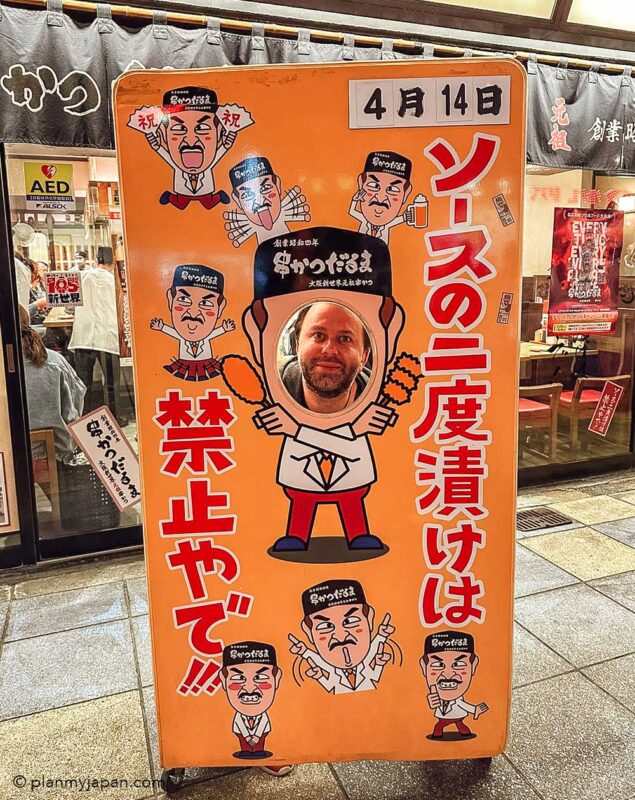
Expect queues in the evening but it is a lot quieter in the day. Also, one of the most weird and wonderful things in Japan, take a ride on the Don Quijote ferris wheel in nearby Dotonbori and you’ll see a HUGE 20 foot tall kushikatsu man statue looking out over the city – surreal!

You might like – Our guide to Don Quijote stores or how to take a spin on Japan’s only Don Quijote ferris wheel in Osaka
Some of the other famous Shinsekai kushikatsu restaurants include:
Kushikatsu Daikichi Shinsekai
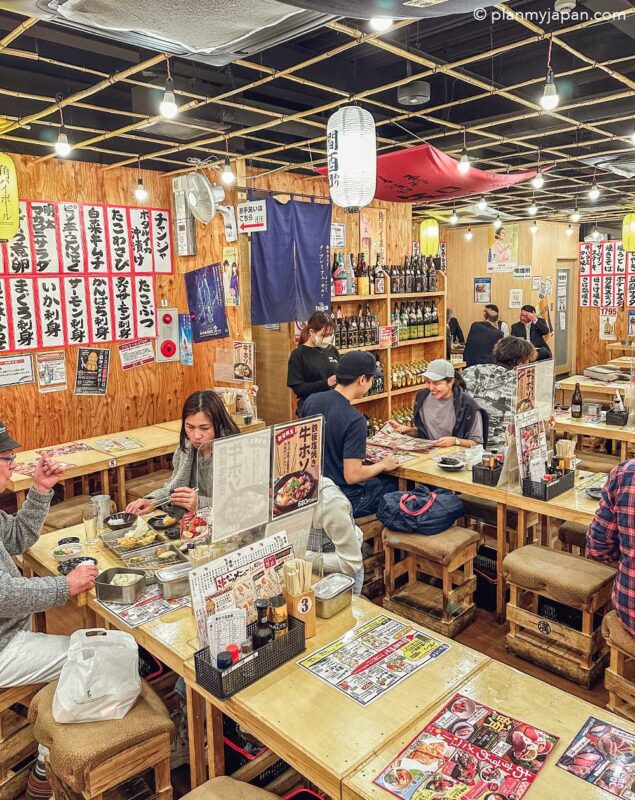
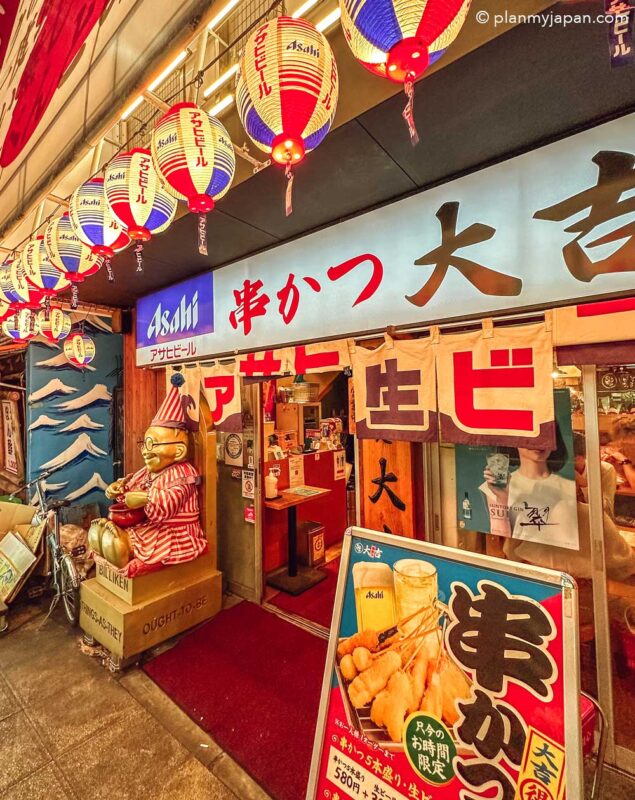
We went to Kushikatsu Daikichi Shinsekai for the nice interiors plus happy hour menu where we got 5 skewers each and a beer for 580 Yen per person.
The food was good, the staff were friendly and the menu easy to follow.

Try this – Osaka local bar & izakaya crawl evening tour in Uranamba area >
Yokozuna Tsutenkaku shop
This is a 24 hour joint in Shinsekai known for its incredible interior that lights up at night.
Just be aware in 2024, there are a few recent reviews of tourists unaware they have to pay for the appetizers that are served at the start – if you don’t want them, refuse them or don’t eat them.

Try this – Osaka City, backstreets of Shinsekai half day food tour >
Kushikatsu Takoyaki Ajinodaimaru
Famous for its huge octopus sign (possibly the most iconic awning in Shinsekai since the demise of the puffer fish sign), Kushikatsu Takoyaki Ajinodaimaru is always busy and has a huge menu and seating area inside.

Found this article helpful?
Did you enjoy our blog post? Let us know in the comments or by sharing it on social media.
You can follow us on:
Instagram
Tik Tok
Facebook
Pinterest
YouTube