
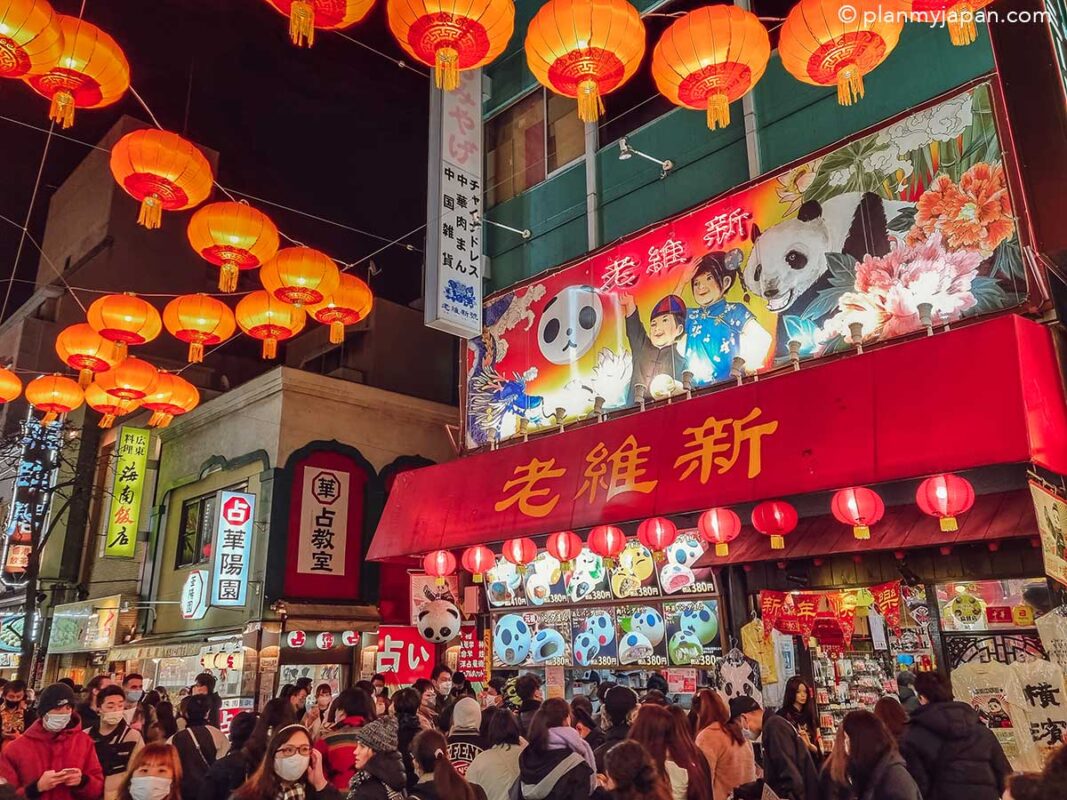
The largest Chinatown in Japan, Yokohama’s vibrant and colorful Chinese neighborhood (横浜中華街) is one of the top things to do in Yokohama.
Yokohama’s Chinatown developed near the harbor after Yokohama’s port opened to foreign trade in 1859 which attracted many thousands of Chinese settlers to the city. It is now one of the best and busiest places to visit in Japan’s second biggest city.
This post may contain affiliate links to tours and hotels. These help us earn a small commission at no additional charge to you.

Today you’ll find a large number of food stands lining the narrow streets, plus around 500 restaurants – many of which offer all-you-can-eat deals (so great if you are visiting Japan on a budget).
Visiting Yokohama Chinatown is a real culinary treat and popular food items you must try include panda-man (panda-shaped steamed buns), koshou mochi (Taiwanese black pepper buns), Peking duck wraps, xiao long bao (soup dumplings) and milk tea.
From tranquil temples to super-cute shopping (plenty of panda toys!), here is our ultimate guide to Yokohama’s Chinatown.


Join our Facebook Japan Travel Tips Group!
Need help with your Japan itinerary or have any questions?
Head on over to our friendly Facebook group with 130,000+ members and ask the experts!
Click here to join our group >
We also run a brand new Japan Hauls, Souvenirs and Shopping Tips group >
Or if you just want to see more of our Japan photos and videos, follow our Plan My Japan Facebook page >
You might like – 30+ things to do in Yokohama >
How to get to Yokohama Chinatown
The nearest Yokohama Metro stations to Chinatown are Motomachi-Chūkagai Station (a 1 minute walk away) and Nihon-Odori Station.
The nearest JR train station to Yokohama Chinatown is Ishikawachō Station – it is a 10 minute walk on foot.

Japan checklist
We love using booking.com and agoda.com (use the Agoda code TAIWANDERERS for a discount) for researching and booking all our hotels. You can also purchase eSIMs from Airalo.
For booking tours, transfers and SIM cards we recommend Get Your Guide, Viator or Klook.
For booking rental cars visit Discover Cars.
Check out our Japan travel resources page >
You might like – Our guide to the Yokohama Nissin Cup Noodles Museum >
How to get to Yokohama from Tokyo
The best way to reach Yokohama from Tokyo is to take the Tokaido Shinkansen high-speed rail from Tokyo Station to Shin-Yokohama Station. The journey takes just 18 minutes and the trains leave every 15-30 minutes.
A one-way ticket for a reserved seat is 3,210 yen; and 1,380 yen for an unreserved seat. If you have a Japan Rail Pass then this route is included. Ticket prices are correct as of 2024.
To transfer to Chinatown, take the Negishi Line from Yokohama Station to Ishikawachō Station.

Try this – Yokohama Tours with Viator >
History of Yokohama Chinatown
With a population of around 4,000 local residents plus ten of thousands of visitors from Japan and all over the world every day, Yokohama’s Chinatown is a popular spot for good food and traditional temples.

Established in the late 1850s, the area developed quickly to serve the port and process the imports and exports (the vast majority of which were from China, the USA and UK).
It was a designated foreign settlement area where immigrants were allowed to settle whilst they conducted their businesses.

The area was devastated by the Great Kanto Earthquake in 1923, with over 1,500 deaths in the Chinatown area alone and with many buildings razed to the ground.
Now Japan’s largest Chinatown with around 500 restaurants, shops and stalls, the Mazu Miao temple was built recently to mark the area’s 150th anniversary in 2006.


You might like – Our guide to Shin Yokohama Ramen Museum >
Arriving in Yokohama Chinatown
We were lucky enough to be in Japan’s largest Chinatown for Chinese New Year, so the streets were packed at night, with hundreds of lanterns across the street plus regular Dragon dances and lots of cultural activities.


We visited Chinatown both during the day and night and we found it had a lot more character and atmosphere from sunset onwards, especially as crowds gathered at the temples to worship and pay their respects.
You’ll also notice that each of the main street entrances to Yokohama Chinatown are marked with highly decorated gates, which light up at night. It is one of the best looking Chinatowns we have seen.


Try this – Yokohama Chinatown food tour with a local guide >
Yokohama Chinatown street food and restaurants
A marvellous mix of sit-down restaurants, takeaway stalls and hole in the wall joints, you will never go hungry in Chinatown (and they have some epic all you can eat experiences (‘Tabehoudai’ in Japanese).
From excellent xiao long bao to delicious duck wraps (plus some of the cutest panda buns you’ve ever seen), there is something to suit all tastes (and budgets) in Yokohama Chinatown.

That said, for the more popular places like Houtenkaku, you may need to queue at peak times. The panda bun place was also super-popular.
Some of the best street foods to try in Yokohama Chinatown include:
Fried xiao long bao soup dumplings (Yaki Shoronpo)
We ate our body weight in delicious dumplings whilst in Chinatown – the fried soup dumplings we’ve tried at Houtenkaku (map) were the best we had in Japan.

And locals and tourists seem to know it as the queue was massive at times. The meaty broth inside is so flavourful but just remember to let them cool down first or create an air hole otherwise you might get a face or mouth full of red hot broth – and believe us, it is hot at the start!


You might like – Our guide to Yokohama’s viral 7-Eleven Hammerheads craft beer store >
Steamed Panda buns / animal buns
Ok, so it may not be the tastiest street-food in Chinatown Yokohama, but one of the most popular snacks and foods we saw were animal and panda buns (and no, there is no actual panda inside just chocolate).

There are various flavors and colors available including a pretty pig faced pork bun and a baby shark style bun – there seems to be a lot of food colouring that goes into these buns so buyer beware.

You might like – Our guide to Yokohama Red Brick Warehouse >
Peking Duck pancakes
Available in many restaurants plus several takeaway places, served in wraps with hoisin sauce. Ducking tasty but they can be quite messy.

You might like – Our guide to the Yokohama Kirin Brewery Tour including beer tasting at the end >
Fried Sesame / Taro Balls (Age Goma Dango)
Good things come in small packages including this sublime sesame ball (tasty but quite greasy / fatty).
You’ll find fried sesame balls all over Yokohama Chinatown and it is one of the cheapest Chinese street foods to eat.

You might like – Our guide to Japan’s plastic fake food (‘sanpuru’) >
Koshou Mochi (Taiwanese black pepper buns)
One of our favourite foods (we love Taiwan), this is simply peppered pork in flaky pastry. Another hot bun that you need to let cool down before taking a bite out of it.
Check out our sister site on Taiwan – Taiwanderers.com >


You might like – Our guide to Japan’s top 20 chain restaurants >
Bubble tea
There are lots of bubble tea shops in Chinatown, including a popular branch of Tamanocha which also serves up tapioca and fried chicken.

Hedgehog bun
This cute hedgehog shaped crispy bun snack is filled with sweet custard cream and costs just 120 yen each. It is sold outside the Yoseigo supermarket ヨウセイゴウ売店 (map).

Taiwanese scallion pancake
Taiwan’s famous crispy green onion pancakes are available to buy for 350 yen.

Yokohama Chinatown temples and shrines
There are a multitude of temples and shrines to explore in Yokohama, but perhaps two of Yokohama’s finest (Taoist) temples can be found in Chinatown.
The two main Chinese temples in Chinatown are the Mazu Miao temple and the Kuan Ti Miao temple.
We were lucky enough to visit both during Chinese New Year and they were a flurry of activity, festooned with red lanterns and colorful banners – both temples were free to visit and packed with worshippers.


Kuan Ti Miao temple is the oldest of the Yokohama Chinatown temples having been built in 1871. Mazu Miao is much newer, opened in 2006 to celebrate Chinatown’s 150th anniversary. Whilst different in style, both are well worth a visit.

A little out of Chinatown, other Yokohama shrines include Shomyo Temple, Myokoji Temple and the three storey pagoda Tomyoji temple.
Try this – Hire kimono in Yokohama or save your legs and see Yokohama by segway
Shopping in Yokohama Chinatown
There are lots of shops (and convenience stores) to browse in Chinatown but of the more unusual places is Pandaya, a panda themed gift store and souvenir shop that has pandas throughout.

Pandas are a common theme in the Yokohama Hakurankan Market, with a whole floor of panda items including pandas hanging from the ceiling – this is a popular place to buy local snacks and gifts.


If you love pin badges, you’ll find lots of shops in Chinatown selling pin badges and gachapon machines galore – we even found Hello Kitty Yokohama merchandise.
It also had one of the cutest selections of Kawaii t-shirts we found in Yokohama, from shibas to pandas plus more furry finds.


You might like – Our guide to Japan’s biggest UNIQLO (12 storeys) or BIC Camera tax free shopping
Other things to do near Yokohama Chinatown
These Yokohama attractions are within a very short walk of Chinatown (less than 5 minutes).
MEGA Don Quijote Yokohama
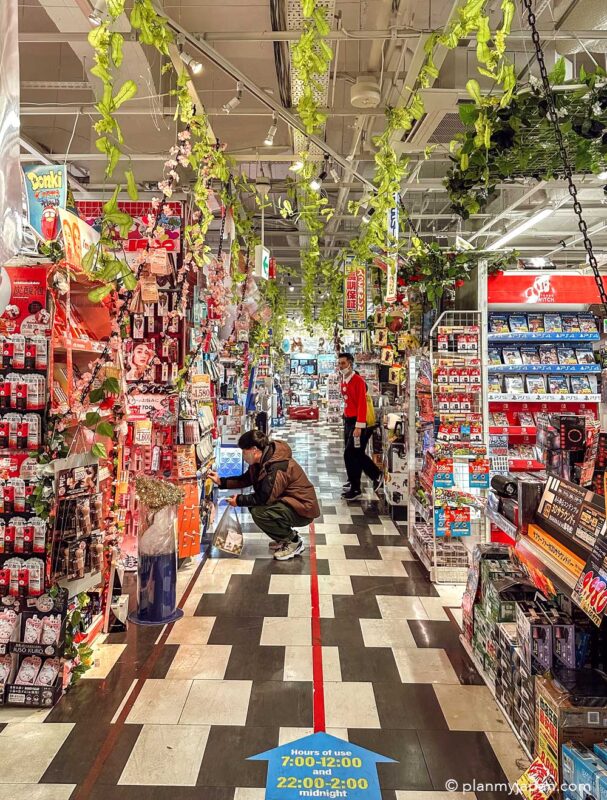
Regular readers of Plan My Japan will know we are HUGE Don Quijote fans. If you are also a Don Quijote addict or occasional shopper, you’ll be glad to hear there is a massive MEGA Don Quijote in Yokohama a short walk from Chinatown.

Open from 9am to 4am daily, the MEGA Don Qujote Yokohama branch is one of the biggest discount stores in Japan and this particular Don Quijote has an underwater sea theme (very appropriate for Yokohama, given it is a famous port city).
You might like our guide to Don Quijote Japan stores or Japan’s only Don Quijote ferris wheel in Osaka.
You might like – Guide to Yokohama Landmark Tower observation deck >
Hikawa Maru
Moored in Yokohama harbour by Yamashita Park, Hikawa Maru is a majestic cruise ship that was originally built in the 1930s which spent much of its time as a hospital ship during World War II.
It is said it carried more than 25,000 passengers when in service and Hikawa is now a permanent museum ship and floating attraction.

Try this – One day private tour of Yokohama with a local or a Chinatown eating and walking tour
Yokohama Motomachi shopping street
Located between Chinatown and the European style Yamate neighborhood, we discovered the Motomachi Shopping Street after a trip to the Mega Donki store nearby – the difference in shopping experiences was quite extreme!

Motomachi Shopping Street is a peaceful boulevard style shopping street full of cute cafes, stylish fashion shops and restaurant retreats.
Famous brands along Motomachi street include Fukuzo, Star Jewellery and the Tudor style Poppy Menswear (the latter could almost be a British style Japanese Hub Pub, what with its black and white wooden facade!)
You might like – Our guide to Tokyo’s top shopping malls and districts including Ginza
Chinatown Yokohama Tours
Hopefully we’ve given you enough information to explore and eat your away around Yokohama Chinatown but if not, there are several tours of Chinatown you may want to check out:
- Yokohama Chinatown trip gourmet tickets >
- Yokohama Chinatown eat and walking tour >
- Yokohama Cup Noodles Museum and Chinatown guided tour >
- Yokohama ramen and Chinatown eating tour >
- Yokohama City, eat like a local in Yokohama >

Yokohama Chinatown Accommodation
There are some good hotels in and around Chinatown including:
Hyatt Regency
Chic hotel located in Chinatown near the Yokohama Marine Tower. Facilities include a grill restaurant, buffet eatery, bar and fitness centre. Check out prices and availability for Hyatt Regency Yokohama
APA Hotel & Resort Yokohama Bay Tower
A little further afields, this is where we stayed in Yokohama. It is a popular chain hotel with amazing views from the higher floor rooms. Facilities include a spa with 10 open-air baths, indoor and outdoor pool and a fitness center. Check rates and availability for APA Hotel & Resort Yokohama Bay Tower

Check out other Yokohama accommodation here on Booking.com>
Found this article helpful?
Did you enjoy our blog post? Let us know in the comments or by sharing it on social media.
You can follow us on:
Instagram
Tik Tok
Facebook
Pinterest
YouTube